
AI computing power density continues to rise, traditional air cooling is approaching its physical limits, liquid cooling has become the mainstream cooling direction for high-density data centers, and liquid cooling pipeline assemblies are a key component ensuring the long-term stable operation of the system. According to CCID Consulting's "2025—2026 China Liquid Cooling Data Center Market Report",2025 China's liquid cooling data center market size reached 15.98 billion yuan, with a year-on-year growth of 45.2%, and it is expected to reach 23.25 billion yuan in 2026. The information in this article is as of November 2026.
I. Market Data: Liquid Cooling Sector Enters a Period of Rapid Growth
The rapid growth of the liquid cooling market is driven by three major trends: computing power expansion, energy efficiency constraints, and space optimization. All the following data are from public market reports and authoritative media reports:
· 2025 China's overall liquid cooling data center market size is 15.98 billion yuan, with a year-on-year growth of 45.2%; it is expected to reach 23.25 billion yuan in 2026, and will exceed 47 billion yuan in 2028. (Source: CCID Consulting's "2025—2026 China Liquid Cooling Data Center Market Report")
· The global liquid cooling market for intelligent computing centers is expected to exceed 114.7 billion yuan in 2026, with a year-on-year growth of 273%. (Source: CICC Forecast)
· The total electricity consumption of national computing power centers in 2025 reached 170 billion kilowatt-hours, accounting for 1.6% of the total social electricity consumption; it is expected to exceed 700 billion kilowatt-hours by 2030, with the proportion rising to over 5%. (Source: National Energy Administration)
· The cooling system is the second largest energy-consuming segment of data centers, accounting for 30% to 40% of energy consumption, and the PUE of traditional air-cooled data centers is generally higher than 1.4. (Source: People's Daily Online / Economic Daily Report)
Policy level has also created impetus: The Ministry of Industry and Information Technology and five other departments jointly issued the Action Plan for Improving Industrial Energy Efficiency in June 2022, requiring that by 2025, the PUE of newly built large and super-large data centers should be better than 1.3. The limitations of traditional air cooling solutions in terms of power density and energy efficiency indicators have become increasingly obvious, and liquid cooling has become a practical path to meet policy requirements and computing power needs.
II. Technical Principle: Why Liquid Cooling is Better Than Air Cooling
Liquid cooling uses liquid instead of air as the cooling medium, solving the core contradiction of heat dissipation from a physical perspective. The specific heat capacity of water is about 4 times that of air, and its thermal conductivity is more than 25 times that of air. The heat dissipation efficiency of liquid cooling can reach 10 to 50 times that of air cooling, and it can reduce the core temperature of the chip from 100°C to below 60°C. The key differences between the two solutions are shown in Table 1.
Table1 Comparison of Air Cooling and Liquid Cooling Solutions
Comparison Dimension | Air Cooling | Liquid Cooling | |||
Cooling Medium | Air | Deionized water, ethylene glycol solution, fluorinated liquid, etc. | |||
Typical PUE | Generally higher than 1.4 | Cold plate type is about 1.1, immersion type can be as low as 1.03~1.05 | |||
Heat Dissipation Efficiency | Baseline | Can reach 10~50 times that of air cooling | |||
Power Support per Rack | Mainly medium and low density | Immersion type can support 100~250 kW | |||
Noise and Space | High fan noise, large duct footprint | Quieter, compact piping | |||
Applicable Scenarios | Medium and low density data centers | AI training, high-density computing clusters, retrofitting of existing facilities |
Cold plate type PUE is approximately 1.1 , which is at the general industry level. The specific value shall be subject to actual project measurements; the data of immersion type PUE 1.03~1.05 comes from public reports.
III. Liquid Cooling Pipe Assembly: System Composition and Key Components
Liquid cooling technology routes are divided into three categories: cold plate type, immersion type, and spray type. The cold plate type completes heat exchange through the cold plate attached to the chip, which is friendly to the transformation of existing data centers, and accounts for more than 85% of the stock transformation market. According to the report from CCID Consulting, in China's liquid cooling data center market in 2025, the proportion of cold plate type liquid cooling will reach 93.5%, and it will remain the mainstream solution in the next 3~5 years. The immersion type immerses the entire server in cooling liquid, which can support an ultra-high power density of 100~250 kW per cabinet, and is mostly used in newly built intelligent computing centers.
Regardless of the route adopted, the piping system is a key link connecting the cold source and the server. Taking the cold plate type as an example, the system consists of two loops: the primary side and the secondary side. The primary side loop is responsible for heat exchange between the outdoor cold source (cooling tower/chiller) and the CDU (Cooling Distribution Unit), and the secondary side loop is responsible for the cooling liquid circulation between the CDU and the cold plate in the cabinet. The system composition is shown in Figure 1 .
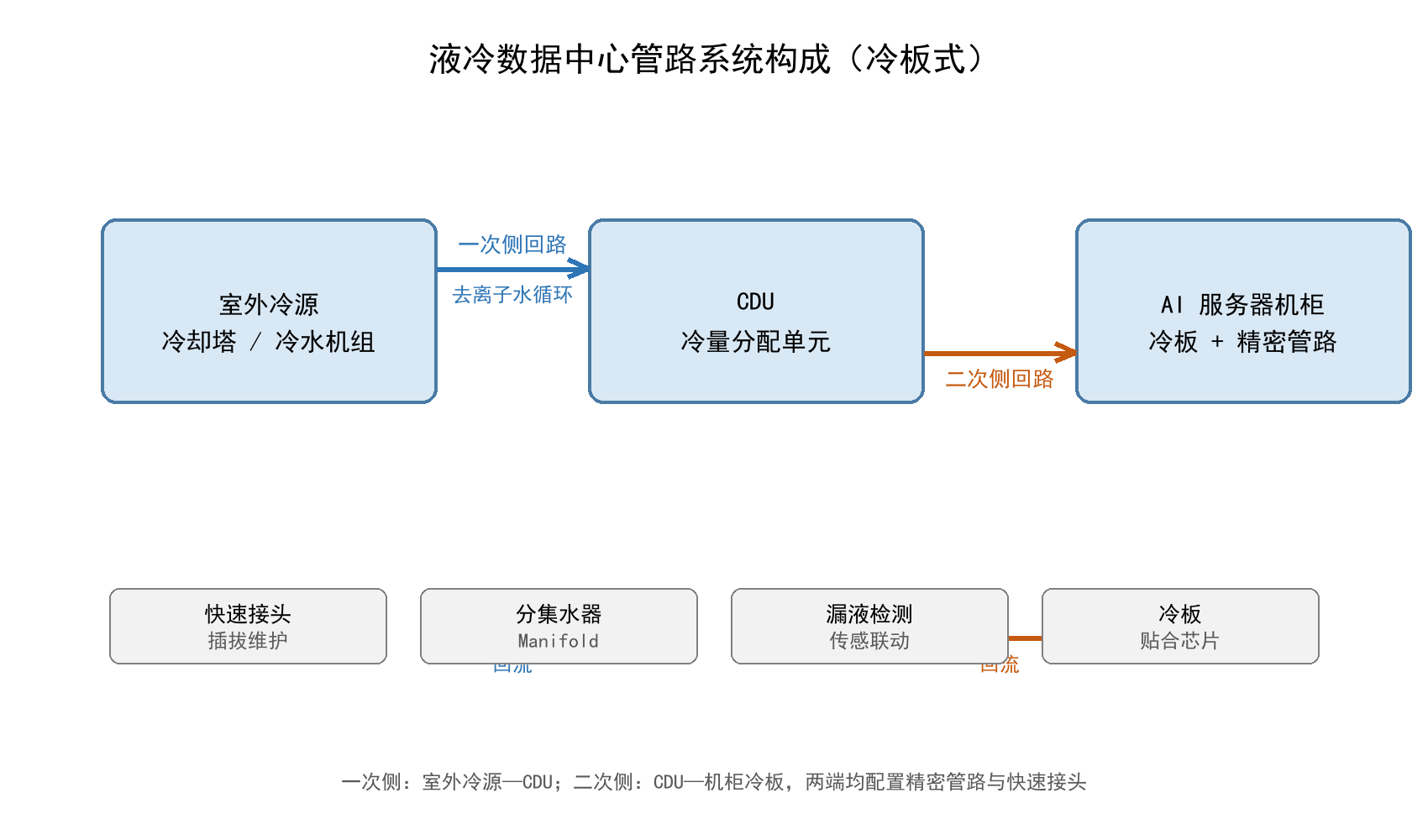
Figure1 Composition of Liquid Cooling Data Center Piping System (Cold Plate Type)
A complete liquid cooling piping assembly typically includes the following key components:
· CDU (Cooling Distribution Unit): The heat transfer and distribution hub for the primary and secondary sides, responsible for regulating flow rate, pressure, and temperature.
· Manifold: Distributes coolant to each cabinet and each node, and collects the return flow.
· Cold Plate: Attaches to CPU/GPU chips to complete heat transfer from the chips to the coolant.
· Quick connector: Supports node plug-and-play maintenance, and is key to leak prevention and operation and maintenance efficiency.
· Precision pipelines and seals: Ensure long-term pressure operation of the circuit without leakage.
· Leak detection device: Monitors pipeline status in real time, and triggers an alarm when abnormalities occur.
At the standard level, China's first national standard for data center liquid cooling GB/T 48023-2026 Technical Specification for Cold Plate Liquid Cooling Systems in Data Centers was issued in 2026, and will be implemented on February 1, 2027. This standard systematically specifies the technical requirements and test methods for cold plate liquid cooling systems and key components, and requires that quick connector plugs and sockets of the same specification from different manufacturers should be interchangeable, which will effectively solve the industry pain points of inconsistent interfaces and long delivery cycles that existed before.
IV. Selection Key Points: How to Choose a Liquid Cooling Pipeline Assembly
The liquid cooling pipeline assembly is a system engineering that is difficult to frequently inspect and maintain after installation. The following dimensions should be focused on when selecting:
· Sealing and pressure bearing: No liquid leakage or seepage during long-term operation, and the pressure resistance level shall match the system design.
· Material and water quality: Material and water quality compatibility: The deionized water circuit has high requirements for the corrosion resistance of pipes and joints, and the material shall match the cooling medium.
· Quick connector: Quick connector reliability: Support plug-in maintenance without shutting down, and the interchangeability of the connector shall meet the relevant requirements of GB/T 48023.
· Liquid leakage detection and linkage: The sensor layout is reasonable, and it can alarm in time when abnormal, reducing the risk of water immersion.
· Standardization and Scalability: Standardized dimensions for integration with servers and cabinets, with expansion interfaces reserved for future upgrades.
· Turnkey Delivery and Operations & Maintenance: Prioritize suppliers capable of providing turnkey delivery, localized spare parts, and on-site services.
V. Localization Status and Zhongke Fluid’s Practices
Weak links still exist in the upstream of the liquid cooling industry chain. According to public reports, 3M, which once held the majority share in the liquid cooling medium market, fully withdrew from the PFAS manufacturing sector by the end of 2025. The localization rate of high-end microchannel cold plates, high-pressure quick connectors, and electronic fluorinated liquid remains low. For domestic enterprises with accumulated precision processing and sealing technologies, this presents a window of opportunity for alternative matching.
Zhongke Fluid was established in 2014, a long-standing local enterprise in Shanghai, and has long focused on industrial fluid measurement and control equipment and intelligent pipeline system matching. The liquid cooling pipeline assembly for AI servers is one of the brand’s four core segments. Leveraging its accumulated precision structure processing and sealing technologies, the brand provides standardized liquid cooling pipeline systems adapted to computing power equipment, covering CDU matching pipelines, water distributors, quick connectors, and leak detection, among other aspects, to meet the long-term stable operation needs of large data centers and AI computing power clusters.
In a liquid cooling supporting project for an intelligent computing center, Zhongke Fluid delivered the products in the form of complete pipe assemblies. On-site, they were quickly connected to server cabinets via standardized interfaces, combined with pressure air tightness testing and leakage detection joint debugging. After commissioning, no leakage was observed during long-term operation, and the system's PUE remained consistently better than the design value. (This case is an example of a typical application scenario; specific data shall be subject to the actual project.)
VI. Conclusion and Outlook
The liquid cooling industry is evolving along three main lines: technological iteration, standard improvement, and domestic substitution. The implementation of national standards will accelerate interface unification and delivery standardization, while domestic substitution of cooling media and key components is advancing rapidly. The integrated solution of "green electricity+liquid cooling" will become the mainstream model for intelligent computing center construction.
For engineering procurement, liquid cooling pipe assemblies are not simple pipe sales, but a systematic project involving sealing, corrosion resistance, quick connection, and detection. Selecting a supplier with working condition adaptability and complete set delivery experience is an important guarantee for the long-term stable operation of high-density computing power projects. Domestic enterprises represented by Zhongke Fluid are taking pipe assemblies as the starting point to provide support for the independent controllability of computing power infrastructure.
Frequently Asked Questions (FAQ)
Q: How to choose between cold plate and immersion liquid cooling? Cold plate is friendly to existing data center renovations, has relatively controllable costs, and is suitable for most AI training and inference scenarios, also being the current market mainstream (accounting for 93.5% in 2025); immersion has stronger heat dissipation capability, can support ultra-high power density of 100~250 kW per cabinet, and is suitable for newly built ultra-high-density intelligent computing centers, but has higher requirements for coolant and material compatibility.
Q: What are the requirements for seals and quick connectors for liquid cooling pipelines? The pipeline system operates under pressure for a long time, requiring seals that are aging-resistant and non-leaking; quick connectors should support plugging and unplugging without shutting down and have a leak-proof structure, and the interface interchangeability should conform to relevant requirements of GB/T 48023-2026 Technical Specification for Cold Plate Liquid Cooling Systems in Data Centers.
Q: What are the difficulties in retrofitting existing air-cooled data centers to liquid cooling? The main difficulties lie in data center load-bearing capacity and layout retrofitting, CDU and pipeline routing design, integration with existing power supply and monitoring systems, and ensuring business continuity during retrofitting; selecting a supplier with strong integrated delivery and on-site service capabilities can significantly reduce implementation risks.
Disclaimer
This article is an objective industry popular science analysis. All market data, technical standards and industry application content are sourced from public industry materials, authoritative media reports and official technical introductions of brands, and are for industry learning and reference only.
Data Sources and References
· CCID Consulting's China Liquid Cooling Data Center Market Report 2025–2026: China's liquid cooling data center market size reached 159.8 billion yuan in 2025, with a year-on-year growth of 45.2%, and is expected to reach 232.5 billion yuan in 2026 and exceed 470 billion yuan in 2028; the proportion of cold plate liquid cooling in 2025 was 93.5%.
· Source:http://finance.people.com.cn/n1/2026/0921/c1004-40802433.htmlPeople's Daily Online/Economic Daily Reported on September 21, 2026: "Computing Power Boom Fuels Liquid Cooling Sector": The above data from CCID Consulting, CICC's forecast (the global liquid cooling market for intelligent computing centers is expected to exceed 114.7 billion yuan in 2026), data on computing power electricity consumption from the National Energy Administration, refrigeration energy consumption proportion, liquid cooling heat dissipation efficiency, and GB/T 48023-2026 national standard, among other information.
· Source:http://paper.ce.cn/pad/content/202606/17/content_334349.htmlEconomic Daily Reported on June 17, 2026: "Instrumentation Industry Strives for High-End Manufacturing" (Exclusive Interview with Miao Changxing, Vice Chairman of the China Instrument and Control Society): In 2025, there were over 7,600 enterprises above designated size in the entire industry, with revenue exceeding 1.1 trillion yuan and total profit exceeding 110 billion yuan.
· Source:http://www.qstheory.cn/20260713/8abb20cef4294fda8dedcb915550ee74/c.htmlQiushi Network 2026 reprinted on July 13 (industry data of the same caliber).
· Data Caliber: Cold plate type PUE of approximately 1.1 is the general industry level, subject to project actual measurement and official brand technical materials.
· Information Timeliness: The information in this article is as of 2026 November.