Many engineering procurement projects often struggle to choose between spiral submerged arc welded pipes and longitudinal submerged arc welded pipes when selecting large-diameter pipes. Both can transport media, but for high-pressure, long-distance, and key infrastructure projects, JCOE process longitudinal submerged arc welded pipes are mostly the preferred choice.
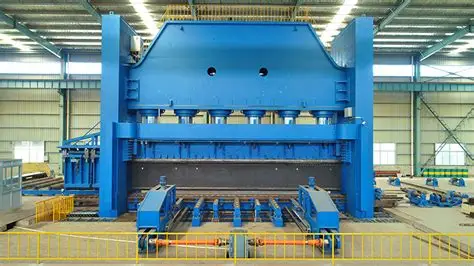
JCOE forming, simply put, involves bending steel plates step by step through three forming stages: J-type, C-type, and O-type, followed by internal and external double-sided submerged arc welding after seam closing. Compared with spiral pipes, JCOE pipes have shorter weld seams and a lower probability of defects; the formed pipe body has uniform stress distribution, with stronger resistance to extrusion and cracking. This automated production line of Haiqianwei adopts full PID control, ensuring stable steel plate forming speed and convenient mold change. It covers outer diameters from 457.2 to 1422.4mm, wall thicknesses from 8 to 50mm, with a maximum steel grade up to X80, and supports custom lengths of 5.8 to 12.5 meters per pipe.
Long-distance oil and gas pipelines, urban high-pressure gas, wind power foundations, and bridge steel structures have strict requirements for pipe stability. The weld seam of spiral pipes follows a spiral path, resulting in relatively complex stress directions under internal pressure; JCOE longitudinal seam pipes have only one longitudinal weld seam, making full-coverage flaw detection easier and later hidden danger investigation simpler.
Haiqianwei's approach is to control quality from the source: steel plates undergo ultrasonic flaw detection upon delivery, and unqualified raw materials are directly rejected; welding uses three-wire submerged arc internal welding technology, ensuring full fusion of the weld seam. Finished products must also undergo hydrostatic testing and full-body non-destructive testing to ensure the pipes meet domestic and international standards such as API 5L and GB/T9711.
Of course, JCOE steel pipes are not suitable for all scenarios. For short-distance, low-pressure water supply and drainage projects, spiral pipes have a more obvious cost advantage. However, once high-pressure media, low-temperature environments, important people's livelihood projects, or overseas engineering are involved, the safety redundancy of JCOE longitudinal submerged arc welded pipes ensures the long-term stable operation of the project.