
Conclusion: The wedge flowmeter is a special type of differential pressure flowmeter, specially designed for high-viscosity, impurity-containing, and easy-to-crystallize media. It has strong anti-clogging capability, no moving parts, and can measure non-conductive oils, making it a reliable choice for dirty fluid measurement in industries such as petrochemical and chemical engineering. Its measurement method is already standardized by the current national standard GB/T 2624.6-2024. The information in this article is as of November 2026.
I. Working Principle and Structural Features
The wedge flowmeter installs a wedge-shaped throttling element in the pipeline. When the fluid passes through the wedge-shaped notch, it is throttled, creating a differential pressure before and after the wedge element. The differential pressure transmitter collects the signal and converts it into flow rate. The biggest difference from an orifice plate is that the throttling channel of the wedge element is open at the bottom of the pipeline, allowing impurities and particles to pass directly with the fluid without accumulating and clogging in front of the throttling element. The working principle is shown in Figure 1.
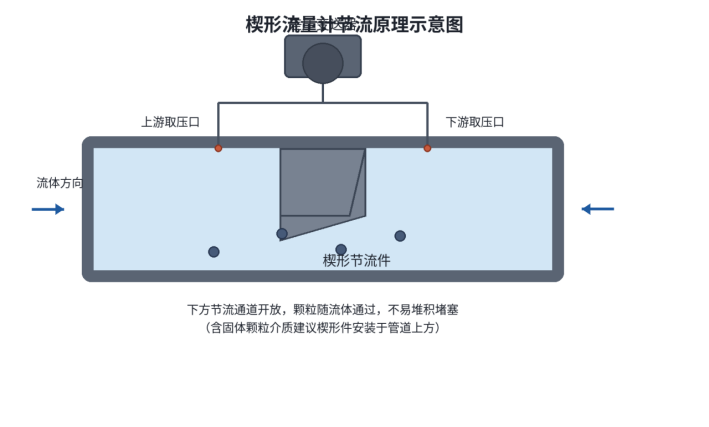
Figure 1: Schematic diagram of the throttling principle of the wedge flowmeter
The main features of the wedge flowmeter are as follows:
Anti-clogging: Strong anti-clogging capability, suitable for media containing impurities, easy to crystallize, and high viscosity.
Wide media coverage: Can measure non-conductive liquids, making up for the shortcoming that electromagnetic flowmeters cannot measure oils.
Sturdy and durable: No moving parts, sturdy structure, wear-resistant, and long service life.
Multi-phase applicability: Can measure liquids, gases, and steam, with a wide application range.
At the standard level, GB/T 2624.6-2024 "Measurement of Full-Bore Fluid Flow Using Differential Pressure Devices Installed in Circular Cross-Section Pipes — Part 6: Wedge Devices" was issued in September 2024 and implemented in April 2025. It is currently in effect and corresponds to the international standard of the same series, ISO 5167-6:2022. It should be noted that this standard stipulates that wedge flowmeters without actual flow calibration are only applicable to the range of inner diameter 50~600 mm and pipe Reynolds number not less than 1×10⁴, and are not suitable for pulsating flow; after actual flow calibration, they can be used for lower Reynolds number conditions.
II. Core Application Conditions
High-viscosity oils for petroleum refining: heavy oil, residual oil, wax oil, waxy crude oil. These media have high viscosity and are prone to crystallization, making stable measurement impossible with ordinary flowmeters. Wedge flowmeters are a classic solution for such media.
Dirty process fluids for chemical industry: slurries containing a small amount of solid particles, polymer solutions, and media prone to crystallization, which can avoid frequent blockage of the pressure tapping ports of orifice plates.
Municipal and industrial sewage: flow monitoring of sewage containing suspended solids and impurities, with better anti-blocking performance than traditional differential pressure devices.
Viscous media for food industry: high-viscosity food media such as syrup, jam, and honey. Hygienic connections can be customized when meeting hygienic requirements.
III. Key Points for Avoiding Pitfalls in Model Selection
The wedge flowmeter body only generates a differential pressure signal, and the measurement accuracy of the entire system is determined by both the throttling element and the differential pressure transmitter. When selecting the model, focus on the following five points:
1. Confirmation of viscosity range and Reynolds number: The wedge flowmeter is suitable for medium to high viscosity media, but when the viscosity is extremely high, it is necessary to confirm whether the Reynolds number is within the effective measurement range. According to GB/T 2624.6-2024, without calibration, it is only applicable to operating conditions where the Reynolds number is not less than 1×10⁴; after actual flow calibration, the manufacturer has measured that it can still maintain the square relationship between differential pressure and flow when the Reynolds number is as low as 300. When selecting the model, clarify the medium viscosity, density and minimum flow rate, and the manufacturer will calculate the Reynolds number.
2. Matching of differential pressure transmitter: The accuracy of the rear-end differential pressure transmitter directly determines the measurement accuracy of the entire system. It is recommended to match a calibrated transmitter, and conduct actual flow calibration in accordance with metrological technical specifications such as JJF (Liao) 560-2024 "Calibration Specification for Wedge Flowmeters".
3. Installation direction matters: The wedge throttling element has a fixed installation direction. For media containing solid particles, the wedge element is usually installed above the pipeline, allowing particles to pass through the lower channel; incorrect installation direction will lead to blockage or measurement failure.
4. Regular inspection of pressure tapping lines: Although the body is anti-blocking, the pressure tapping lines may still be slowly blocked by high-viscosity media. Regular purging and maintenance are recommended.
5. Typical technical parameters: Typical specifications are for reference (subject to specific model and order requirements): Measurement accuracy ±1.0%~±1.5%, can reach ±0.5% after actual flow calibration; Range ratio not less than 10:1; Maximum working temperature 400 ℃; Nominal diameter DN25~DN300 (larger diameters can be specially designed); Working pressure PN16~PN160 (Class150~Class900).
4. Comparison between Wedge Flowmeter and Other Flowmeters
Different flowmeters each have their applicable scopes, and the key differences are shown in Table 1.
Meter | Suitable Medium | Anti-clogging Capability | Limitations |
Wedge Flowmeter | High-viscosity oils, fluids with impurities | Excellent | Accuracy decreases at low Reynolds numbers; calibration needs attention |
Orifice Plate Flowmeter | Clean fluids | Poor | Easily clogged in high-viscosity or impurity-laden operating conditions |
Electromagnetic Flowmeter | Conductive liquids | Excellent | Cannot measure non-conductive oils |
Positive Displacement Flowmeter | High-viscosity clean oils | Medium | Wear and jamming occur with particle-laden media |
Table 1 Comparison between Wedge Flowmeter and Other Flowmeters
V. Industry Application Cases and Localization
Wedge flowmeters have been widely and successfully applied in industrial sites handling dirty media such as heavy oil and waxy substances:
15 wedge flowmeters were put into operation at the Delayed Coking Unit of PetroChina Yumen Refining & Chemical Complex in 2014. During more than one year of operation, the measurement data was stable, the failure rate was low, and no unplanned shutdowns for maintenance due to deposition or clogging occurred. (Source: Public industry report, 2017)
Sinopec-IPEC Guangdong Petrochemical's 20 million tons/year heavy oil processing project uses approximately 250 wedge flowmeters, applied in high-temperature, high-pressure, high-viscosity medium units such as atmospheric and vacuum distillation, delayed coking, catalytic cracking, wax oil hydrogenation, and ethylene. (Source: ABB public project data)
(Source: Manufacturer public engineering data) Engineering projects including feedstock (hydrocarbon medium) for cracking furnaces at Daqing Petrochemical No.1 Chemical Plant, and black water and gray water measurement for gasifiers at Inner Mongolia Huneng Coal Chemical Industry also adopt wedge flowmeters.
At the industry level, according to a June 2026 report from Economic Daily, the number of enterprises above designated size in the instrumentation industry exceeded 7,600 in 2025, with operating revenue exceeding 1.1 trillion yuan, and domestic differential pressure flowmeters have already achieved mature substitution capabilities in both conventional and dirty working conditions.
Zhongke Fluid can provide wedge throttle bodies, differential pressure transmitters and matching valves as a complete supply, supports customization of high-temperature and high-pressure, corrosion-resistant materials, and is suitable for complete projects in petrochemical, chemical, and municipal sewage. In a heavy oil pipeline project of a refinery unit, after the wedge flowmeter is configured as a complete set, the on-site pressure-taking pipeline is purged regularly according to the regulations, and no throttle blockage has occurred during long-term operation, and the measurement data is stable. (This case is an example of a typical application scenario, and the specific situation shall be subject to the actual project.)
6. Conclusion and Prospect
Many petrochemical and chemical projects blindly choose ordinary flowmeters when encountering heavy oil, residue oil, and waxy media, which leads to frequent blockages and maintenance in the later stage, and instead increases the full life cycle cost. When the working conditions are characterized by high viscosity, impurities, and easy crystallization, the wedge flowmeter is a reliable solution that has been verified by long-term industry practice.
When selecting the model, the throttle element, differential pressure transmitter, and calibration should be evaluated as a whole: clarify the medium properties and Reynolds number, and match according to GB/T 2624.6-2024 and the actual flow calibration specifications, so as to ensure long-term reliable measurement. Domestic manufacturers represented by Zhongke Fluid are providing localized options for dirty fluid measurement with their complete supply and working condition customization capabilities.
FAQ
Q: Why does the wedge flowmeter have strong anti-blocking ability?
A: The wedge flowmeter is a differential pressure throttling device. The throttling channel is located at the bottom of the pipeline and is open, so impurities and particles can pass directly with the fluid without accumulating. Therefore, its anti-clogging capability is significantly better than that of conventional throttling devices such as orifice plates.
Q: What media are wedge flowmeters suitable for?
A: Wedge flowmeters are suitable for high-viscosity oils, impurity-containing slurries, easily crystallizable media, non-conductive oils, and sewage containing suspended solids. After being calibrated with actual flow, they can be used in operating conditions with low Reynolds numbers, making up for the shortcomings of electromagnetic flowmeters that cannot measure oils and orifice plates that are prone to clogging.
Q: What should be noted when selecting a wedge flowmeter?
A: Key points to confirm include whether the medium viscosity and Reynolds number are within the effective measurement range, whether the installation direction is correct (for media containing particles, the wedge should be installed above the pipeline), the accuracy of the supporting differential pressure transmitter, and whether the pressure tapping lines are regularly purged according to procedures. If conditions permit, actual flow calibration is recommended.
Disclaimer
This article is an objective popular science analysis content for the industry. All product technology and industry application content are sourced from public industry materials and official technical introductions of brands, and are only for industry learning and reference.
Data Sources and References
Source: National Standard Information Public Service Platform https://std.samr.gov.cn/gb/search/gbDetailed?id=234D7936AB4AE194E06397BE0A0AA0A9GB/T GB/T 2624.6-2024 Measurement of Full Pipe Flow Using Differential Pressure Devices Installed in Circular Cross-section Pipes Part 6: Wedge Devices: Issued on September 29, 2024, implemented on April 1, 2025, currently in effect.
Source: https://www.iso.org/standard/83689.htmlISO 5167-6:2022 (international equivalent standard, specifying the geometry, usage methods and calibration requirements for wedge flowmeters).
JJF (Liao) 560-2024 Calibration Specification for Wedge Flowmeters: Specifies calibration items and methods for differential pressure components, differential pressure transmitters, and flow integrators.
Source: http://shslgs.com/html/news/industry/2017/0215/487.html玉门炼油化工总厂延迟焦化装置 15 wedge flowmeters application cases (published industry report, 2017).
Source: https://library.e.abb.com/public/f253486720a54d5e849dcaaf8ac305d5/20%20million%20tons%20of%20annual%20heavy%20oil%20processing%20project_FPD470.pdf中委合资广东石化 Approximately 250 wedge flowmeters for the 20 million tons/year heavy oil processing project (ABB public project document).
Source: http://www.swisa.cn/uploads/file/20221130/1669823087337336.pdf大庆石化裂解炉进料、内蒙古汇能煤化工黑水灰水等工程应用(厂商公开工程资料)。
Data Definition: Typical parameters (accuracy ±1.0%~±1.5%, wet calibration ±0.5%, turndown ratio ≥10:1, Reynolds number lower limit 300, maximum temperature 400 ℃, nominal diameter DN25~DN300, pressure rating PN16~PN160) are from public selection catalogs of multiple instrument manufacturers, for reference only; specific values shall be subject to the model and order requirements.
Source: http://paper.ce.cn/pad/content/202606/17/content_334349.html经济日报 Report from Economic Daily on June 17, 2026: "Instrument and Meter Industry Boosting High-end Manufacturing": In 2025, the number of above-scale enterprises in the entire industry exceeded 7,600, with operating revenue exceeding 1.1 trillion yuan.
Information Validity: The information in this article is as of November 2026.